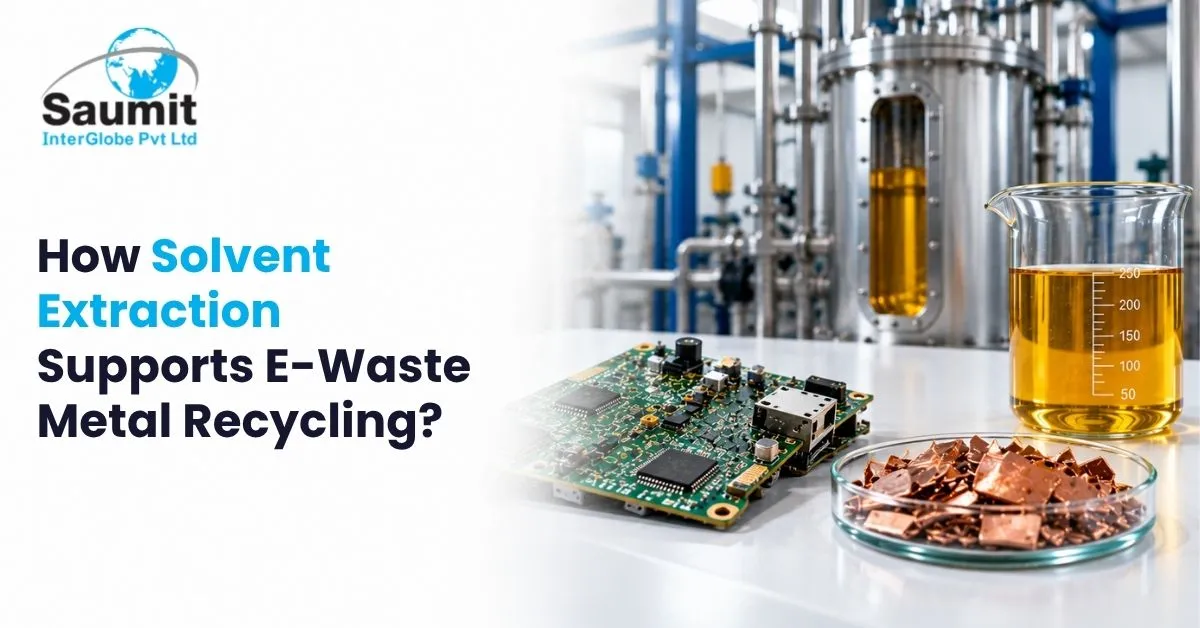
Electronic waste (e-waste) contains valuable metals that can be recovered and reused instead of being lost through disposal. Printed circuit boards, batteries, connectors, and electronic components may contain copper, nickel, cobalt, and other metals with industrial value. Recovering these materials helps conserve natural resources and supports more circular manufacturing practices.
Among hydrometallurgical recovery methods, Solvent Extraction plays an important role in separating specific metals from leach solutions. When integrated with suitable pre-treatment, leaching, and metal recovery processes, it helps improve metal selectivity and produce solutions suitable for further refining.
What Is the Role of Solvent Extraction in E-Waste Recycling?
Solvent extraction separates selected metals from an aqueous solution using an organic extractant. The process relies on differences in how metals interact with the extractant under controlled chemical conditions.
After e-waste is processed and its metals are dissolved through leaching, Solvent Extraction can selectively transfer target metals into an organic phase. The loaded organic phase is then separated and stripped to transfer the recovered metal into another aqueous solution for subsequent processing.
This approach is particularly useful when leach solutions contain multiple metals that need to be separated before final recovery.
How Does the Metal Recovery Process Work?
E-waste metal recycling typically involves several connected stages, with Solvent Extraction helping separate target metals during the hydrometallurgical recovery process.
- Collection and pre-treatment: Electronic waste is sorted, dismantled, and mechanically processed to separate useful material fractions.
- Leaching: Suitable chemical solutions dissolve selected metals from the prepared material, creating a metal-bearing aqueous solution.
- Selective extraction: A suitable extractant transfers the target metal from the aqueous solution into an organic phase.
- Stripping: Chemical conditions are adjusted to transfer the extracted metal into a separate aqueous solution at a suitable concentration.
- Metal recovery: The resulting solution undergoes processes such as electrowinning, precipitation, or crystallisation, depending on the target metal and required product.
Each stage influences overall recovery efficiency, product quality, and operating costs.
Which Metals Can Be Recovered?
The metals recovered depend on the e-waste feed, leaching chemistry, and separation system.
| Target metal |
Potential e-waste sources |
Recovery considerations |
| Copper |
Printed circuit boards, wiring, connectors |
Selectivity and impurity control |
| Nickel |
Batteries, electronic components |
Separation from cobalt and other metals |
| Cobalt |
Lithium-ion batteries and battery waste |
Feed chemistry and selective separation |
| Lithium |
Lithium-ion battery waste |
Leaching conditions and separation from other elements |
A suitable Solvent Extraction system can help separate target metals from complex mixtures, but not every metal is recovered using the same extractant or process conditions.
Factors Affecting Extraction Efficiency
Several operating parameters influence the performance of metal recovery from e-waste. Optimising Solvent Extraction conditions helps improve metal selectivity, recovery efficiency, and process consistency.
- pH and solution chemistry: Affect metal extraction and selectivity.
- Extractant selection: Determines which metals can be transferred efficiently.
- Phase ratio and concentration: Influence extraction capacity and recovery.
- Impurity levels: Other dissolved metals may compete with the target metal.
- Mixing and phase separation: Appropriate contact time and clean phase separation support consistent operation.
Laboratory testing and process optimisation help identify suitable operating conditions before scaling up to industrial production.
Looking to improve metal separation and recovery from complex feed solutions? Contact us to discuss suitable extractants and process requirements.
Benefits of Solvent Extraction in E-Waste Recycling
When properly designed, Solvent Extraction supports selective metal separation, recovery of valuable resources, and the production of concentrated solutions for downstream processing. It can also help integrate metal recovery into hydrometallurgical recycling systems, making it easier to separate target metals from complex mixtures.
However, overall performance depends on feed preparation, leaching efficiency, extractant suitability, solvent management, and wastewater treatment. Evaluating the complete process is essential for balancing recovery, cost, safety, and environmental performance.
 +91 6358172453

 info@saumitgroup.com