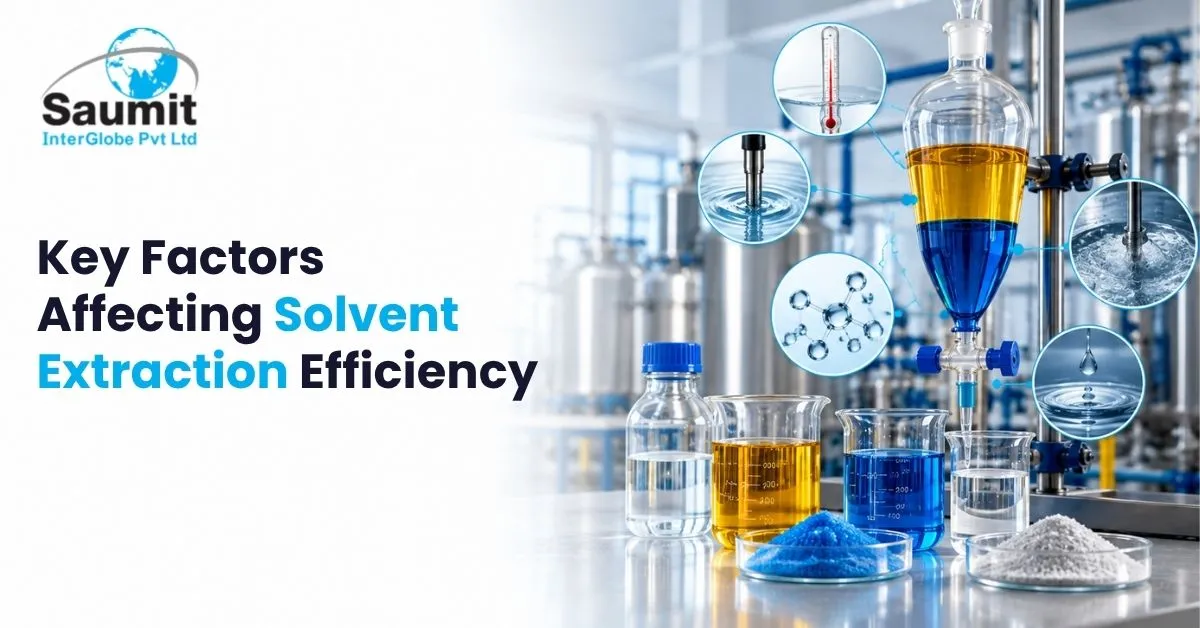
Recovering valuable metals from aqueous solutions requires careful control over chemical reactions, operating conditions, and separation stages. Variations in feed composition, impurity levels, and process parameters can influence metal transfer, product purity, and overall recovery performance. Even a suitable extractant may deliver inconsistent results when operating conditions are not properly controlled.
In hydrometallurgical processing, Solvent Extraction separates selected dissolved metals by transferring them from an aqueous phase into an immiscible organic phase containing an appropriate extractant. The efficiency of this process depends on several interconnected factors, including pH, extractant concentration, temperature, mixing, and phase separation. Understanding these variables helps operators identify performance limitations, improve process stability, and achieve recovery targets for applications such as copper refining, battery recycling, and critical-metal recovery.
1. Extractant Selection
Extractant chemistry plays a major role in determining which metals transfer between the aqueous and organic phases. Different extractants have varying affinities for metal ions, making selectivity an important consideration when treating solutions containing multiple metals.
The right extractant for Solvent Extraction depends on the target metal, feed composition, impurity profile, and required product purity. Compatibility with the diluent and operating conditions should also be evaluated. Laboratory testing helps determine whether an extractant provides suitable loading capacity, selectivity, and stripping performance for the intended application.
2. pH and Solution Chemistry
The pH of the aqueous feed can significantly influence metal speciation and extraction behaviour. Some extractants perform effectively only within a specific pH range, while changes in acidity can affect the transfer of target metals and competing impurities.
During Solvent Extraction, controlling pH helps maintain consistent extraction performance across process stages. Other chemical variables, including oxidation state, ionic strength, and the presence of complexing agents, may also influence metal availability and separation. Feed characterisation is therefore important before selecting operating conditions.
3. Extractant Concentration and Phase Ratio
Extractant concentration affects metal-loading capacity and the amount of target metal that can transfer into the organic phase. Insufficient concentration may limit extraction, while excessive concentration can increase chemical costs or affect viscosity and phase separation.
In Solvent Extraction, the ratio of organic phase to aqueous feed also influences the quantity of metal transferred in each contact stage. Operators should establish a suitable phase ratio based on feed concentration, extraction equilibrium, throughput, and recovery targets rather than relying on a single setting for every application.
4. Mixing and Contact Time
Effective mixing brings the aqueous and organic phases into contact, supporting metal transfer across the interface. Inadequate mixing may limit mass transfer, whereas excessive mixing can create stable emulsions or make phase separation more difficult.
During Solvent Extraction, contact time must allow sufficient metal transfer without unnecessarily slowing production. Equipment design, flow rates, temperature, and fluid properties all influence mixing performance. Optimising these variables helps balance extraction efficiency with throughput and downstream separation requirements.
 +91 6358172453

 info@saumitgroup.com