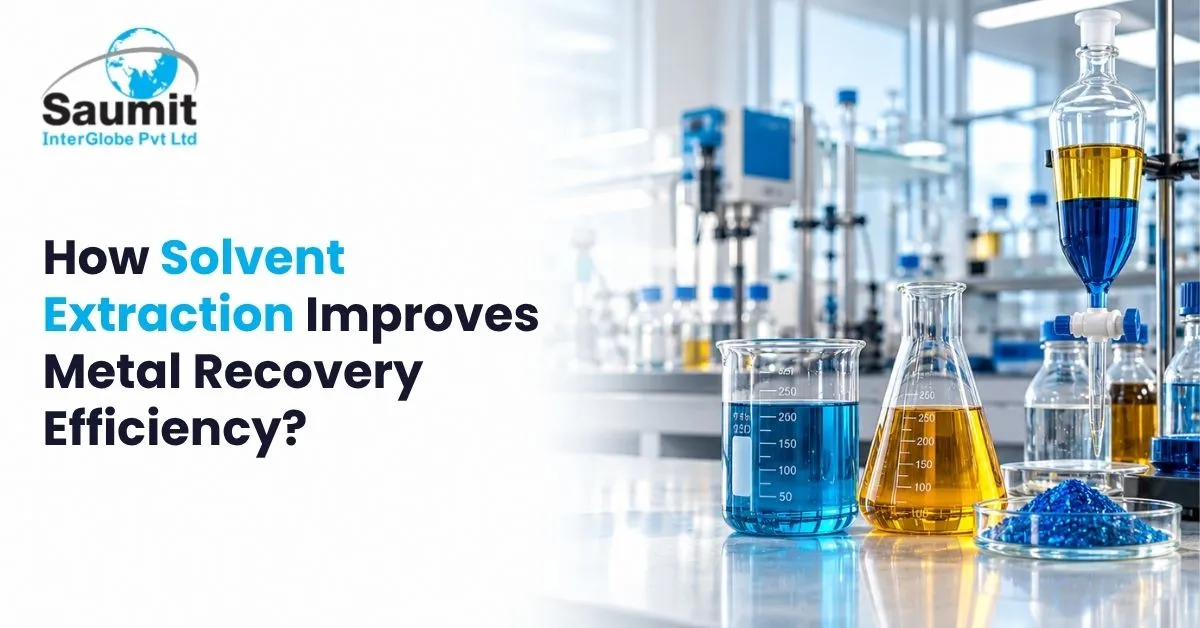
Recovering valuable metals from ores, industrial process solutions, and recycled batteries requires effective separation techniques. These materials often contain several metals and impurities, making it difficult to obtain the desired metal at the required purity. Inefficient separation can increase processing costs, create additional purification requirements, and leave valuable resources unrecovered.
In hydrometallurgy, Solvent Extraction improves metal separation by transferring selected dissolved metals from an aqueous solution into an immiscible organic phase containing a specialised extractant. The process uses differences in chemical behaviour to separate target metals under controlled conditions. When properly designed, it can improve selectivity, reduce impurity carryover, and prepare metal-rich solutions for downstream recovery. These advantages make the technique useful in copper refining, battery recycling, and the processing of critical metals. However, actual recovery efficiency depends on the extractant, feed composition, operating conditions, and overall process design.
How Does Solvent Extraction Work?
The process involves contacting an aqueous metal-bearing solution with an organic phase containing a suitable extractant. During Solvent Extraction, the target metal transfers between the two phases according to its chemical properties and the operating conditions.
The main stages are:
- Extraction: The target metal transfers from the aqueous feed into the organic phase.
- Phase separation: The two liquid phases separate after mixing.
- Scrubbing: If required, impurities are removed from the loaded organic phase.
- Stripping: The target metal transfers into another aqueous solution for further processing.
The resulting solution can undergo electrowinning, precipitation, or another suitable recovery process, depending on the metal being processed.
Keyways Solvent Extraction Improves Metal Recovery Efficiency
1. Selective separation of metals
Different extractants interact with metal ions differently. By selecting suitable chemistry and controlling conditions such as pH, Solvent Extraction can favour the transfer of a target metal while leaving certain impurities in the original solution. This is particularly valuable when processing solutions containing multiple metals.
2. Improved product purity
Impurities can interfere with downstream recovery and affect the quality of the final product. Selective extraction and scrubbing stages help limit the transfer of unwanted elements, reducing the burden on subsequent purification steps.
3. Better recovery across multiple stages
A properly designed extraction circuit can transfer more of the target metal into the desired process stream. By using Solvent Extraction across multiple stages, operators can improve metal transfer and reduce losses when the system is configured for the feed chemistry, extraction equilibrium, and required output specifications.
4. More efficient downstream processing
By separating the target metal from interfering substances, Solvent Extraction can help prepare a solution suitable for subsequent recovery. This can improve process consistency and reduce complications caused by impurities, although the overall benefit depends on the complete process flowsheet.
5. Recovery from recycled materials
Battery recycling produces metal-bearing solutions that may contain lithium, cobalt, nickel, and other elements. Appropriate extraction chemistry can help separate these metals for further processing, supporting resource recovery from secondary materials.
Applications Across Metal Recovery Industries
The choice of extractant depends on the target metal, feed composition, and required product quality. Solvent Extraction supports the selective separation of valuable metals across several hydrometallurgical applications.
| Metal or application |
Recovery objective |
| Copper refining |
Selective copper transfer before electrowinning |
| Cobalt and nickel |
Separation of metals from mixed solutions |
| Lithium recovery |
Selective separation within a suitable recovery process |
| Zinc recovery |
Extraction from compatible aqueous feeds |
| Battery recycling |
Recovery of valuable metals from processed battery materials |
| Molybdenum and tungsten |
Selective recovery from suitable process solutions |
 +91 6358172453

 info@saumitgroup.com